When a shop doesn't ship to your country: your three options
You found it, you want it, and the checkout says the shop does not deliver where you live. That is a decision, not a dead end — but only one of the three ways round it is usually worth taking, and it depends on numbers most people never run.
Shops stop at borders for unglamorous reasons. Handling returns from the other side of the world is expensive, customs paperwork is tedious, and a complaint in a language nobody in the office speaks costs more than the sale was worth. Small labels almost never switch international on; bigger ones often run a separate storefront for your region instead, with a shorter catalogue. Either way the effect on you is the same.
Your three options, honestly ranked
Buy it from a reseller in your own country. Always try this first. If the item is stocked by a local retailer or a large marketplace, you will pay a bit more and be done in a click, with a warranty you can actually use. Nothing below beats that for convenience.
Have it delivered to an address in the shop's country, then forwarded. This is what most people end up doing, and it is what we do. The shop sees a domestic customer, ships domestically, often free; you pay one international leg at the end. It works with almost any shop and any country.
Ask a person to do it for you. A friend, a relative, a traveller. Free in theory, and it works once. Then you discover that receiving, repacking, declaring at customs and queueing at the post office is genuinely a chore, and you stop asking.
There is a fourth thing people try, and it is worth naming so you do not waste an evening on it. A VPN changes where the website thinks you are; it changes nothing about what the shop will ship, what your card will clear, or where the parcel can go. It is the most confidently repeated bad advice in this area.
The arithmetic that decides it
Before going further, work out three numbers. The item price. The shipping to your door, which you can estimate from the weight. And the duties and taxes your country charges on arrival, which nobody can include in advance and which the carrier collects from you at the door.
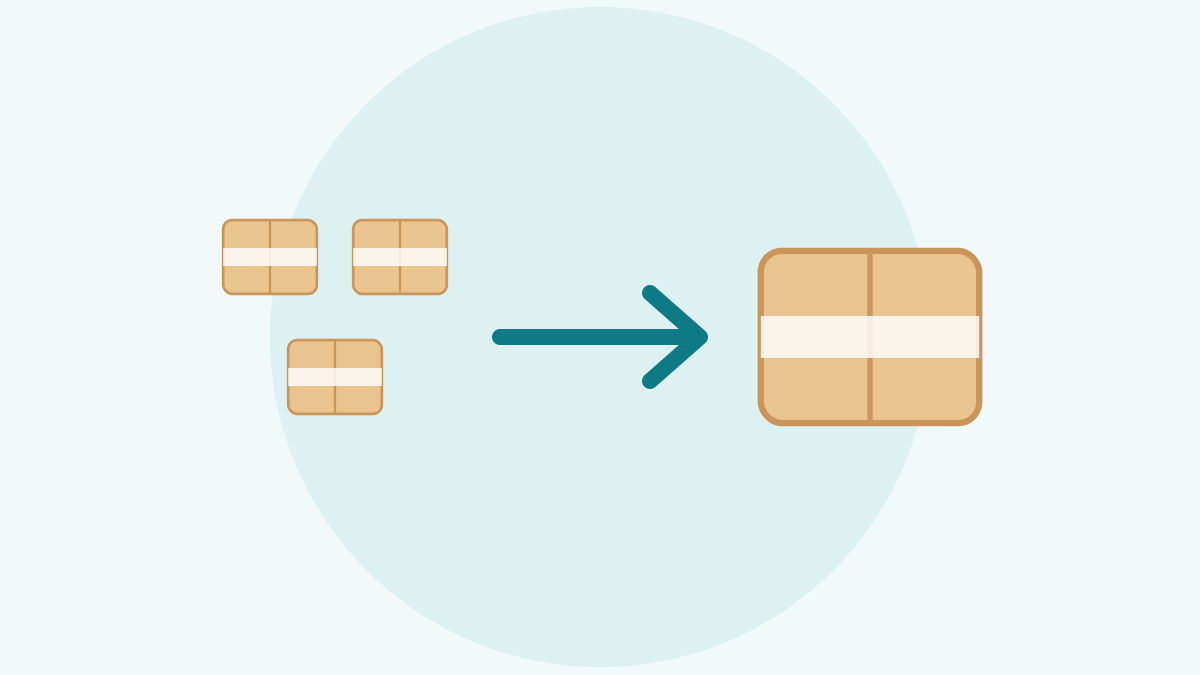
Then apply a rule that will save you money and disappointment. If the shipping is a large share of the item price, do not send it alone. A twenty-euro object with thirty euros of transport is a bad deal on its own and a perfectly good one as part of a full box, because the price of a shipment rises far more slowly than its weight. Six items in one box cost barely more to send than one.
That is why storage matters more than it sounds: with us your purchases wait free of charge for 45 days, precisely so that you can gather enough to make the trip worth it. The full logic of consolidation is here.
When it is genuinely not worth it
We would rather tell you than take your money. Skip it when the object is bulky and cheap — a large light thing is billed on its volume, so you pay to ship air. Skip it when a local equivalent exists at a similar price. And skip it when the item is on the list of things carriers refuse: aerosols, alcohol, most perfume, loose lithium batteries.
It is worth it when the object is small, dense and valuable, or simply unavailable where you live — which, for anything French and second-hand, is most of the time.
Two ways to get a parcel to you
You order yourself. On French sites that accept your card, you enter your FrenchShopper address at checkout. To the shop you're a French customer; the parcel lands at our warehouse, we receive it, and we forward it to you. The address is free and comes with your account.
We buy for you. On Vinted, Leboncoin, and any seller who only ships within France or rejects a foreign card, you send us the link: we check it, quote it, and once you've paid, we buy with our own French account and card. The details are here.
Either way, your items wait for free for 45 days in our warehouse so you can gather several — and everything leaves in one box, with one shipping charge.
The case nobody warns you about
Sometimes the shop does ship to you, and you still cannot have the thing you want. Brands that run a storefront for your region often stock a shorter catalogue there than at home, with import duties baked into the prices. You are redirected by your location, you browse what you are given, and the piece you came for is simply absent — without any message telling you so.
The test takes a minute: open the shop's own-country version in a private window and compare the category you are looking at. If the ranges differ, ordering from the original storefront to a local address there is the only way to get the missing item.
Frequently asked questions
Why do shops refuse to ship internationally at all?
Returns, customs paperwork and support in languages they do not handle. For a small label the occasional foreign order is not worth the process it forces them to build, so they leave the option switched off. It is rarely about you or your country specifically.
Is it legal to have a parcel delivered to a forwarding address?
Yes. You are buying from the shop as a customer in its own country and paying full price, then having your own property shipped on to you. What matters is that the customs declaration on the onward leg states the real contents and the real value — which is why any service offering to under-declare is a service to avoid.
Will I pay tax twice?
No, but you will pay it once and probably not where you expect. You pay the shop's domestic price including its local VAT, then your own country assesses duties and taxes on arrival, on the declared value. Some countries refund the original VAT on export; most people do not bother for small amounts.
Can you buy it for me if my card is refused?
Yes, that is the other half of the service. You send the link, we check the item is still available and at what price, quote you, and buy only after you have paid. Nothing is bought before your go-ahead, and if the item sells in the meantime you are refunded.