Parcel consolidation: how to pay one shipping charge for several orders
Consolidation is the whole point of a French address. Several parcels arrive, one leaves. Here's why it changes the bill so much, what exactly happens on the warehouse table, and the three mistakes that spoil the maths.
An international shipment is expensive for a simple reason: a large part of its price doesn't depend on what's inside. Handling, the customs declaration, handover to the carrier, packaging, customs clearance on arrival, the fee the carrier charges for advancing your taxes — all of that is paid per shipment, whether it weighs one kilo or eight.
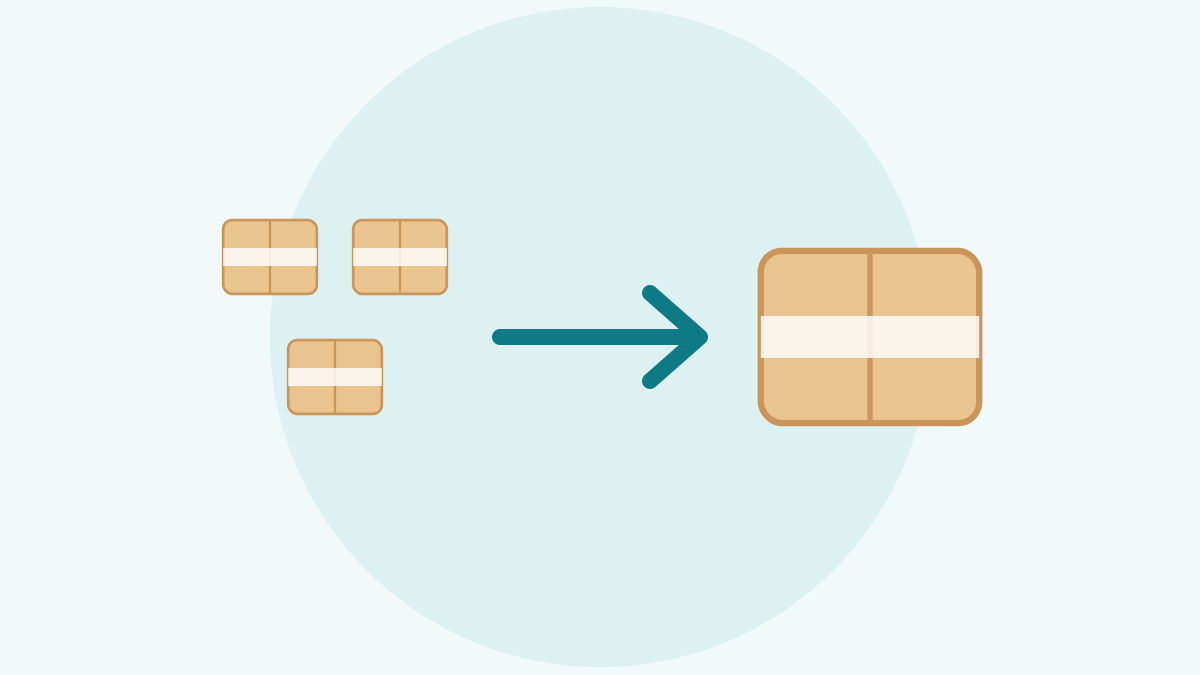
Parcel consolidation means paying all of that only once. You order from three sites, at three different times; the three parcels arrive at your French address; we gather them into one box; one shipment leaves. It's the simplest idea in forwarding, and the most profitable.
What consolidation does to the price
Take three one-kilo orders, shipped separately. You pay three handlings, three declarations, three packagings, three transports — and, on arrival, three trips through customs with three times the carrier's handling fee. Gathered into one three-kilo box, you pay all of that once. The transport itself costs a little more than a one-kilo parcel, but far less than three: the price rises much more slowly than the weight.
There's a second saving, less visible. Carriers charge on the higher of actual weight and volumetric weight, meaning the space the box takes up. Three original boxes, with their padding, their empty space and their corners, take far more room than their contents gathered in a well-fitted box. Consolidating also means removing air — and air, in international shipping, is paid for.
And a third, on the customs side: one crossing, one declaration, one handling fee — instead of three.
What happens on the warehouse table
- You select. From your account, you tick what should go: parcels you had delivered yourself, items we bought for you, or both. The rest waits.
- We open and lighten. The original boxes are opened, surplus packaging removed — overwrapping, padding, boxes inside boxes. What really protects the item is kept.
- We pick the right box. The smallest format everything fits in without forcing, with the protection needed. That's where volumetric weight is won or lost.
- We weigh and measure. The price is calculated on the real box, not an estimate. You then see every shipping offer, with its price and delivery time.
- You choose, you pay, it leaves. One customs declaration, at the real value of the whole, from your invoices.
What we don't do
- We never consolidate without your request: a parcel that arrives waits, it doesn't leave on its own.
- We don't mix in one box things that shouldn't travel together — a liquid and a garment, a fragile object and a heavy one — without protecting them accordingly.
- We don't under-declare the box's value, even if consolidation raised it: the declaration reflects your invoices, and that's what makes the insurance pay out.
The three mistakes that cancel consolidation out
Shipping as you go. Requesting each parcel's shipment as soon as it arrives means paying the fixed costs every time. Storage is free for 45 days precisely so you can wait for the next parcel.
Letting the deadline pass. Beyond the 45 free days, storage fees run per day and per parcel. They're not there to punish you, but to keep the warehouse a place things pass through. Plan your orders so everything lands within the window.
Adding the item that changes the box. A bulky object — a puffer coat, a helmet, a large box — can push the whole lot into the next size up, and the price with it. When that happens, we tell you when building the box: sometimes two medium shipments cost less than one large one, and we suggest it.
Consolidating purchases from different sources
That's the point of having both services in one place. An order you placed with a brand, a Vinted item we bought for you, a Leboncoin object a seller agreed to ship to us: everything arrives at the same address, waits in the same place, and leaves in the same box. You don't have to choose between ordering yourself and handing us the purchase — you do both, and it all comes together.
Frequently asked questions
How many parcels can be consolidated into one shipment?
As many as the box and our carriers' limits allow — up to 25 kg and 300 cm on the longest side. Beyond that, or when one large box would cost more than two medium ones, we tell you and suggest splitting.
Is consolidation charged?
No. Receiving, 45 days of storage and consolidation are included. You only pay the shipping of the box that leaves, packaging and insurance included, at the price shown before you confirm.
Do you open my parcels to consolidate them?
Yes, it's necessary: to remove surplus packaging and fit everything into one box, the original boxes have to be opened. The items themselves aren't unpacked beyond what's useful, and you can ask for photos.
Can I consolidate an item you bought and a parcel I ordered myself?
Yes, it's the most common case. Both wait in the same place and leave in the same box, with one shipping charge.