Volumetric weight: why your parcel is billed heavier than it weighs
Your parcel weighs two kilos, and the carrier bills it as if it weighed five. It's not a mistake: it's volumetric weight, and it decides the price of most international shipments. Here's how it's calculated, and how we bring it down.
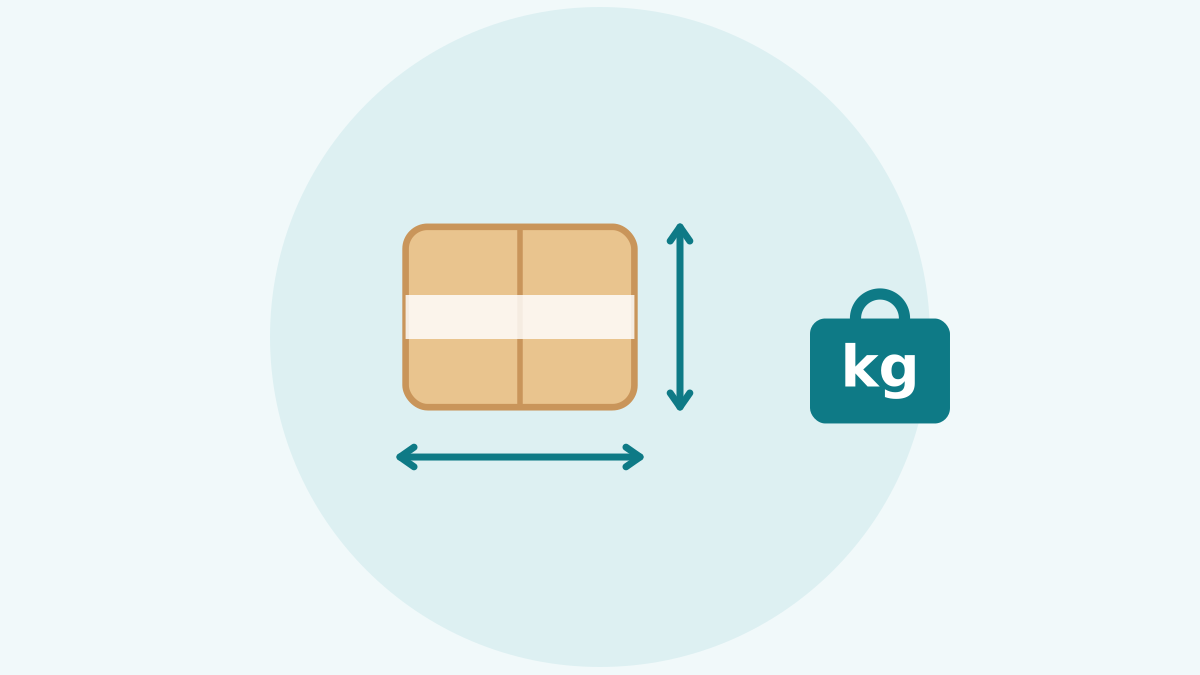
A plane doesn't lack the strength to carry heavy parcels; it lacks room. That's why carriers don't only bill what a parcel weighs, but also the space it takes up. They calculate a volumetric weight from the box's dimensions, compare it to the actual weight, and bill whichever is higher.
A dense parcel — books, shoes — is billed at its actual weight. A light, bulky parcel — jumpers, a coat, headphones in their box — is billed by volume. And most parcels of clothing are in the second case.
The calculation, in one line
Multiply the box's three dimensions in centimetres, and divide by a factor set by the carrier — most often 5,000 for international shipments:
length × width × height ÷ 5,000 = volumetric weight in kilos
A 40 × 30 × 20 cm box is 24,000 cm³. Divided by 5,000, that's 4.8 kg. Whatever you put inside, that box is billed as at least a 4.8 kg parcel. Two kilos of jumpers in that box? Billed as nearly five. Six kilos of books? Billed as six, the actual weight wins.
Three boxes, three billed weights
- 20 × 15 × 10 cm — 3,000 cm³, so 0.6 kg volumetric. A piece of jewellery, a pair of shoes, a garment: almost always billed at actual weight.
- 40 × 30 × 20 cm — 24,000 cm³, so 4.8 kg volumetric. The medium box: three to five pieces, a bag. Billed by volume if it holds textiles, at actual weight if it's dense.
- 50 × 40 × 25 cm — 50,000 cm³, so 10 kg volumetric. The large box: billed as ten kilos even half empty.
You can see the consequence: moving from the medium box to the large one doubles the billed weight, while its volume only grew a little more than twofold. That's why the size of the box often matters more than what's in it.
What it changes when you order
A half-empty box costs the price of a full one. If your shipment is billed at 4.8 kg while it weighs two, you're paying for nearly three kilos of air. Add the next order, the pair of shoes, the second jumper: they travel for free until the actual weight catches up with the volumetric weight. It's the best argument for consolidation.
Original packaging is your enemy. A shoebox inside the shop's box, itself inside our box: every layer adds volume. A headphone box, a perfume box in its display, a handbag box with its stuffing — all of it takes room you pay for.
Light, bulky items are the worst. A puffer jacket, a pillow, a plush toy, a lampshade: almost nothing on the scale, a lot in the plane. Those are the items for which consolidation changes the bill the most.
How we bring volumetric weight down in the warehouse
- We remove what doesn't protect. Overwrapping, marketing boxes, oversized padding. A shoebox can stay if it protects the pair; a shop box around it serves no purpose.
- We pick the smallest box that fits. Not the nearest one to hand: the one everything fits in without forcing, with useful protection. We measure the built box, and the price is calculated on it.
- We pack textiles tight, not fragile objects. Tightly folded clothes travel very well; ceramics don't. We adapt.
- We tell you when splitting is better. When a lot tips into the large box because of a single item, two medium shipments sometimes cost less. We suggest it at the quote stage.
When to estimate yourself
Our estimator lets you pick a box format, or enter your own dimensions if you know them. It applies the same rule as the carriers: the higher of actual and volumetric weight. If you hesitate between two formats, try both — the gap will tell you whether it's better to wait for one more order to fill the large one, or to leave right away with the small one.
Frequently asked questions
Do all carriers use the same factor?
No. The 5,000 factor is the most common for international express shipments, but some services use another, and postal shipments are sometimes billed differently. What never changes: it's always the higher of actual and volumetric weight that's billed. Our offers reflect each carrier's own calculation.
How do I know whether my parcel will be billed at actual weight or by volume?
Do the maths: length × width × height in centimetres, divided by 5,000. If the result exceeds the actual weight, volume will be billed. In practice, a box of clothes is almost always billed by volume; a box of books or shoes, at actual weight.
Can you put my items in a smaller box so I pay less?
That's exactly what we do at consolidation: we remove surplus packaging and pick the smallest box that fits, without sacrificing protection. The price is calculated on the real box, weighed and measured.
Does volumetric weight also apply to the French overseas territories?
Yes, the principle is the same on every destination we serve, overseas France included: the carrier takes the higher of actual and volumetric weight. A full box is always the best deal.