Parcel forwarding from France to Germany: no customs, one shipping charge
Germany is well served by online retail, and most French chains deliver there. Here is what a French address actually gets you in Germany, the delivery times we measure, and why customs never enters the calculation.
Germany is well served by online retail, and most French chains deliver there. The requests we get from Berlin, Munich or Hamburg come from elsewhere: the resident French community after specific labels, and Germans buying on French sites that do not ship abroad — antiques, car parts, instruments, old furniture.
This guide explains what a French address really gets you inside the EU, how the price of a shipment is built, and why customs never enters the equation. The exact price of your parcel to Germany is worked out live on our estimator, from its weight and size.
What a French address actually changes
Let us be straight about it, because you will check anyway: plenty of French retailers already deliver to you. If you are ordering from a large chain, you need nobody. This guide does not pretend otherwise.
A French address earns its keep in three specific situations, and they come up more often than you would think.
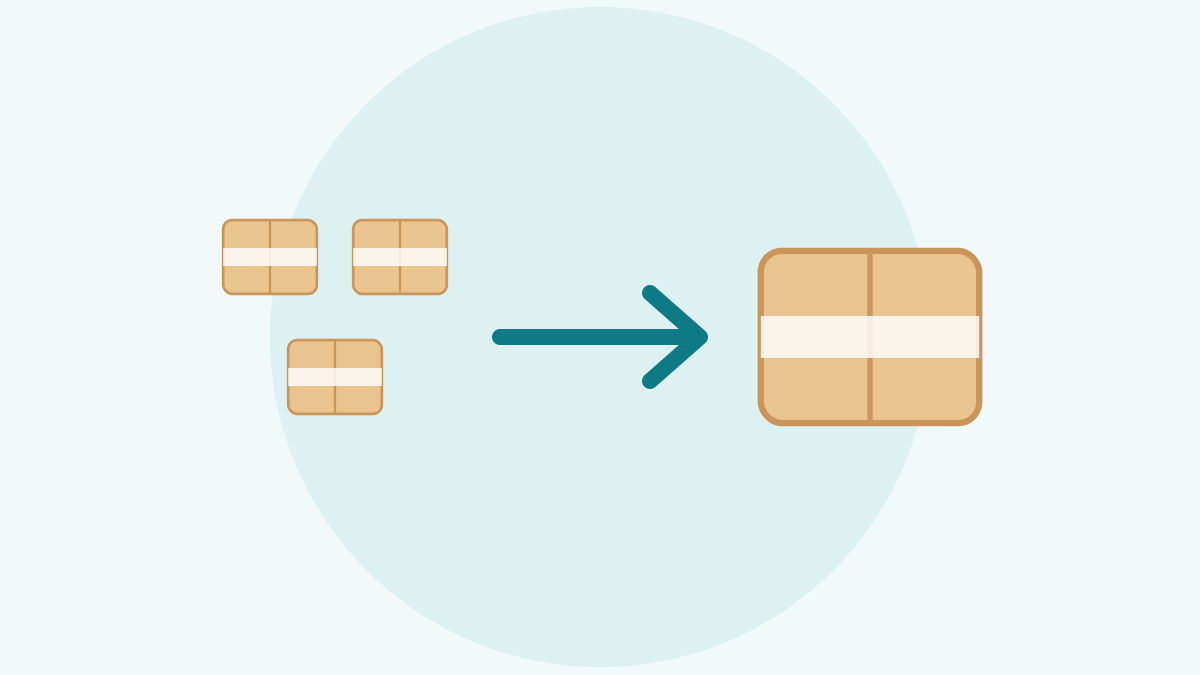
You are ordering from several shops at once. Each one bills you its own international delivery, usually dearer than its domestic one, and sometimes free within France but paid to you. Have them all deliver to your French address and you pay a single shipment for the lot — and delivery to us is frequently free, being domestic.
The shop still refuses to leave France. Small labels, designers, specialist sites, equipment shops: many never switched international on, or switched it off because handling returns wore them down. To them, your French address makes you an ordinary customer.
You are buying from a private seller. This is the most tightly shut case, and it has nothing to do with the EU: Leboncoin ships nowhere outside France, and private sellers will not take on a foreign shipment. That is where we buy on your behalf.
The good news: no customs
Germany is in the European Union and your parcel leaves from France, so there is no customs border. No duties, no import VAT, no declaration to fill in, no carrier handling fee, and nothing that can be held on arrival. The parcel travels like a domestic shipment.
That is the big difference from every other destination we serve, where part of the final cost is unknown to everyone until delivery. Here, what you see before you pay is what you pay. It is worth saying plainly, because fear of surprise charges is what makes most people give up.
Two ways to get a parcel to you
You order yourself. On French sites that accept your card, you enter your FrenchShopper address at checkout. To the shop you're a French customer; the parcel lands at our warehouse, we receive it, and we forward it to you. The address is free and comes with your account.
We buy for you. On Vinted, Leboncoin, and any seller who only ships within France or rejects a foreign card, you send us the link: we check it, quote it, and once you've paid, we buy with our own French account and card. The details are here.
Either way, your items wait for free for 45 days in our warehouse so you can gather several — and everything leaves in one box, with one shipping charge.
How the shipping price is built
Our price covers transport, packaging and insurance, and it depends on two things: the weight of the box and its size. Carriers charge on whichever is higher, actual or volumetric weight — a big half-empty box is billed as if it were full. For every shipment to Germany, you see all the available offers, with their price and delivery time, before you pay.
The rule that matters: the price rises far more slowly than the weight. A lone 1 kg parcel is the worst ratio between what you get and what you pay; several orders in one box is the best. Estimate your parcel from its real weight, before you order anything.
The delivery times we measure
On our own measurements to Berlin, Colissimo quotes delivery five days after handover, Chronopost about a week, Mondial Relay nine days to a pickup point. Proximity and the sheer volume of traffic between the two countries make this a fast, inexpensive destination.
Pickup points deserve a mention in Germany, where the Paketshop habit is deeply rooted. Several of our offers deliver to a relay point rather than your door, often cheaper and with far wider opening hours than a postal round. If nobody is home during the day it is almost always the better choice — and it appears in the list of offers, with its price and delivery time.
Frequently asked questions
Do I really need you, since French retailers deliver to Germany?
For a single order from a large chain, no, and we will not pretend otherwise. We earn our keep in three cases: when you order from several shops and want one shipment instead of three, when the shop does not ship outside France, and when you are buying from a private seller who cannot send you their parcel.
Are there customs charges to Germany?
None at all. Germany is in the European Union and the parcel leaves from France: no customs border, no duties, no import VAT, no declaration, no handling fee. The price you see before paying is the final price.
How long can my purchases stay with you?
Forty-five days, free of charge, from the day each item arrives. That is what makes consolidation possible: you order over several weeks, everything waits, and you decide when the box leaves.
Can I mix my own orders with things you buy for me?
Yes, and that is the most common case. An order you placed yourself with a French retailer and an item we bought from a private seller land at the same warehouse, leave in the same box, and pay for one shipment.