Filling in your forwarding address on a French site, without mistakes
Your French address fits in five lines, and only one really counts: the code line. Here's how to enter it on a French shop, on Vinted, on a marketplace — including when the form doesn't have the right number of boxes.
Every day, parcels arrive at the warehouse without anyone knowing whose they are. Not because the address is wrong — they did arrive — but because the one thing that ties them to someone is missing: the personal code. This guide explains how to fill in your address so that never happens to your parcels.
What your address looks like
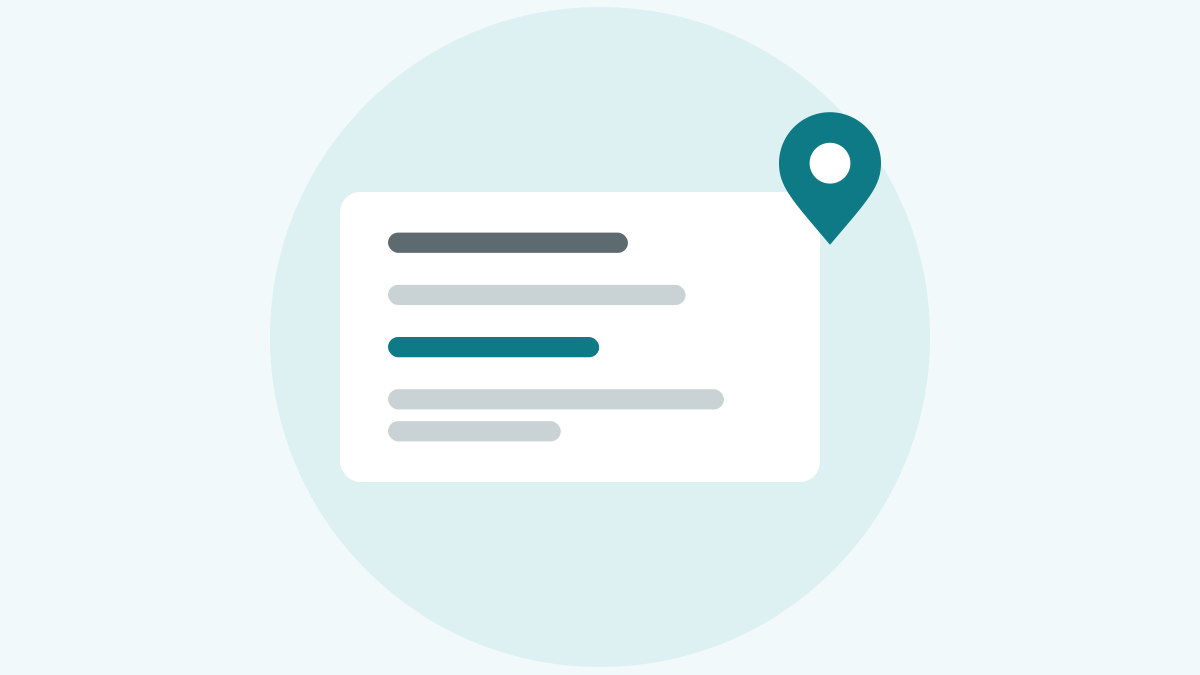
It appears in your account as soon as you create it, with a button to copy it in one go. It has five lines:
The format
- First name Last name — yours, as they appear on your account.
- Chez FrenchShopper — your code — the essential line. The code looks like FS- followed by six characters.
- Street and number — the warehouse's, given in your account.
- 25200 Montbéliard, France.
- Phone — the warehouse's, given with the address. Many carriers refuse to ship without a recipient number, and we're the ones receiving.
The code is what lets us assign a parcel to you with certainty among everything that arrives. The name helps, but there are namesakes, and many orders are delivered in someone else's name. The code belongs to you alone.
Site by site, where the code goes
A form with two address lines. The most common case. Line 1: the street and number. Line 2, often called "address line 2", "building" or "apartment": Chez FrenchShopper — FS-XXXXXX. Your name in the name field, the phone in the phone field.
A form with a single address line. Put the code in the name field, after yours: First name Last name — FS-XXXXXX. Then the street on the address line. The printed label will carry the code next to the name, which is what's needed.
A "company" field. Write FrenchShopper — FS-XXXXXX in it. Some carriers print that field large above the name: perfect.
Vinted, when we buy for you. You have nothing to enter: we buy, to our address, with our account. If you buy on Vinted yourself with an accepted card, the delivery address is set in your Vinted profile, with the same rules — the code in the address line 2.
A site that rejects dashes or special characters. Write Chez FrenchShopper FS XXXXXX, without the dash: we read the code all the same.
The phone: the warehouse's, not yours
The number on the address is the one the carrier will call if it can't find the recipient or if a parcel needs an appointment. Since we're the ones receiving, it's our number to give — it's provided with the address in your account. A foreign number on a French address sometimes makes the order fail, or blocks a delivery waiting for a call nobody will receive.
After the order: declare the parcel
As soon as the merchant sends you a tracking number, declare the parcel in your account. It's the second way we recognise it on arrival — and the only one if the code got lost in printing. We track it automatically all the way to the warehouse, and you're told when it arrives, weight included. For an item we buy for you, nothing to declare: we handle it.
The three mistakes that delay a parcel
- No code. The parcel arrives, nobody claims it, it waits in the identification area. We often end up finding its owner through a declared tracking number or the name — but it takes days, and without a declaration, it may not succeed.
- A different name from the account's. An order placed in a partner's, a parent's, a nickname's name: if the code isn't there either, the parcel can't be tied to anything. Put the code, always.
- A pickup-point delivery. Some sites default to collection at a pickup point near the address. Choose home delivery: a parcel dropped at a pickup point in Montbéliard doesn't reach us, and goes back to the sender after a few days.
If you forgot the code
Declare the parcel with its tracking number as soon as you notice: that's what will let us recognise it. And if the merchant still lets you change the delivery address, do it. A parcel received without a code or a declaration isn't lost, but it waits for someone to claim it — you.
Frequently asked questions
Where do I find my personal code?
In your account, under "My French address", as soon as you create it. A button copies the full address, code included, to paste as is on a French site.
The site only has one address line — where does the code go?
In the name field, after yours: "First name Last name — FS-XXXXXX". The label will then carry the code next to the name, and that's exactly what we need to assign the parcel to you.
Which phone number should I give?
The warehouse's, provided with your address: we're the ones receiving, and we're the ones the carrier must be able to reach. A foreign number on a French address sometimes blocks the order.
I forgot the code on an order — what now?
Declare the parcel in your account with its tracking number: that's the second way we recognise it on arrival. And if the merchant still lets you edit the address, add the code.